August 31, 2026
Beyond Chopin: Marie Kiyone and the Road Ahead After 15 Years
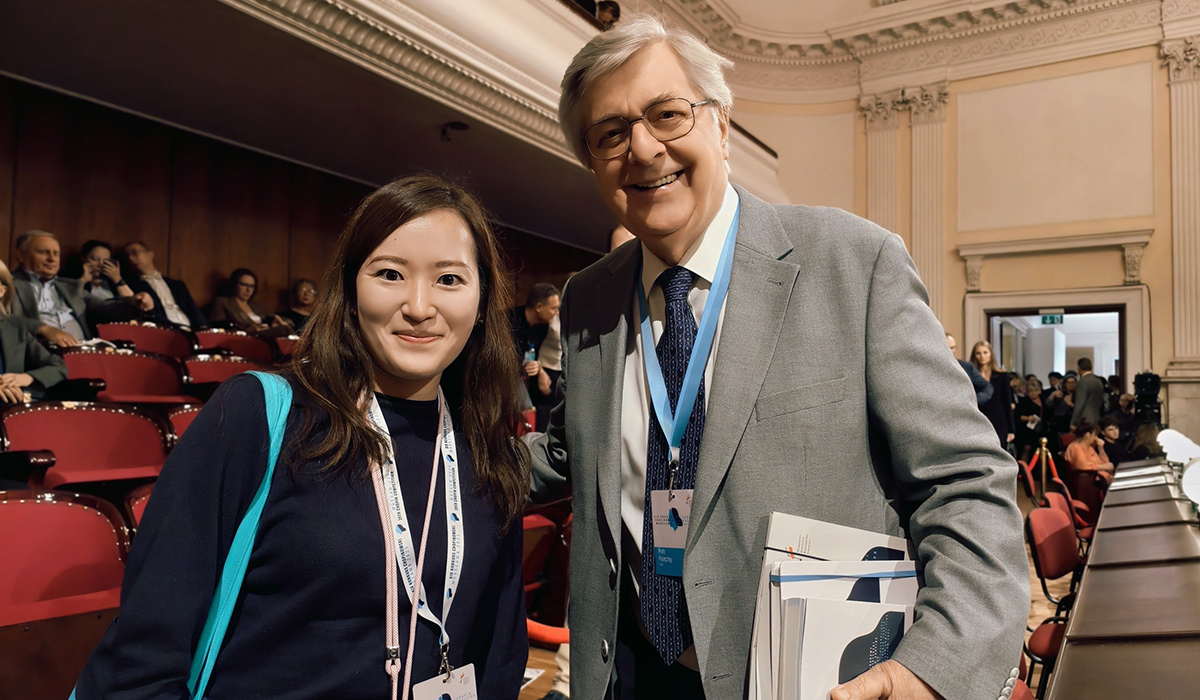 With Professor Piotr Paleczny at the 2025 International Chopin Piano Competition
Born in Kanazawa, Ishikawa Prefecture, Kiyone attended Tokyo College of Music High School before moving to Poland in 2008 to study at the Fryderyk Chopin University of Music in Warsaw. In 2010, she participated in the International Chopin Piano Competition and received a diploma. From 2012, while continuing her studies in Warsaw, she also trained at the International Piano Academy “Incontri col Maestro” in Imola, Italy. In 2017, after eight and a half years in Europe, she returned to Japan. Since then, she has continued to perform primarily in Japan, Poland and Italy, while expanding her work to include teaching the next generation and promoting international exchange.
Her 15th anniversary, however, is not simply an occasion to look back over her career. Over those years, she has grown from a music student into a pianist who interprets works through her own sensibility and communicates those ideas to audiences through performance. Today, through education and international exchange, she has also begun to play a broader role in connecting music with society. This recital is therefore both a reflection on 15 years of growth and change and a declaration of the next step in her journey.
What Has Changed ― and What Has Not
Fifteen years ago, Kiyone was still a student in Poland. At the time, giving a single recital felt like a major event in itself. Studying and preparing for the performance carried enormous significance.Fifteen years later, she has returned to Japan and appeared on numerous stages as a professional pianist. “In some ways, I now feel freer to do what I want,” she says.
Her desire to continue developing as a performer remains unchanged. Yet she now has greater emotional space to explore works she genuinely wants to perform and to take on new activities beyond the concert stage.
One thing, however, has remained constant: she has never regarded the stage as merely a place to display her playing. For Kiyone, a concert is a place where she communicates with the audience — not through words, but through music and the atmosphere shared in that moment. Her aim is to give the audience everything she is capable of at that particular point in her life. That conviction has remained with her since her student days.
Looking Back on 15 Years Through Music
For her anniversary recital, Kiyone has selected works by Schumann, Brahms and Chopin. The program begins with Schumann’s Arabeske in C Major, Op. 18 and Brahms’s Piano Sonata No. 1 in C Major, Op. 1. The second half features Chopin’s Scherzos Nos. 1 and 2 and Ballades Nos. 3 and 4.All three composers are central figures of the Romantic era, but this program also reflects Kiyone’s own 15-year journey. Chopin represents Poland, where she spent eight and a half years, and he is also the composer whose music she has performed most frequently throughout her career.
For her 10th-anniversary recital, Kiyone presented an unusual all-Chopin program consisting entirely of polonaises and mazurkas. She remembers that several audience members said they would also have liked to hear works such as the ballades. With those comments in mind, she chose two ballades and two scherzos for this year’s program. Brahms’s Piano Sonata No. 1 carries another, more personal story. When Kiyone was studying in Italy, her teacher once told her, “If you are going to play a Brahms sonata, it should be the First.”
At the time, however, she could not imagine herself performing the work. The years passed, and her teacher eventually died, but those words remained with her. Now, she finally feels that the time may have come to play it. Precisely because this is her 15th anniversary, she wants to confront a work that once seemed beyond her reach.
Schumann’s Arabeske also holds special memories. Kiyone performed it in an examination during her first year at university in Poland. Fifteen years later, she will return to music she played in her youth and interpret it once again as the artist she is today. This is more than a collection of celebrated compositions. The program is designed as a meeting on a single stage between the young pianist she was 15 years ago, the musician shaped by her years in Europe, and the artist she has become.
How Poland Changed Her Life as a Pianist
It is impossible to discuss Kiyone’s musical life without considering the eight and a half years she spent in Poland. Surprisingly, before studying abroad, she had not performed much Chopin and did not regard him as a composer to whom she was particularly well suited.One of the main reasons she went to Poland was the opportunity to study with Professor Piotr Paleczny, who served for many years as deputy chairman of the jury of the International Chopin Piano Competition. In 2010, soon after arriving in Poland, Kiyone entered the competition herself. Before she realized it, Chopin had become the composer with whom she would spend more time than any other.
“I became a completely different kind of performer from the one I had imagined before studying abroad,” she reflects. Her years in Poland transformed her. Yet it was not only her teachers and the university that shaped her as a musician. Polish audiences attended her concerts, listened to Chopin performed by a young student from another country, and received her warmly. “I was truly nurtured by that atmosphere,” Kiyone says. Learning music is not simply a matter of reading a score or being taught technique and interpretation. It also means living where the music was born, meeting its people, and experiencing firsthand how they respond to it. Her eight and a half years in Poland taught her precisely that.
Chopin in Japan and Chopin in Poland
How, then, does the Chopin experienced by Japanese listeners differ from the Chopin understood by Polish audiences? When asked this question, Kiyone, drawing on her many years in Poland, answers without hesitation. “They are different.”She believes the image of Chopin widely admired in Japan is strongly associated with the sophisticated composer he became after moving to France: delicate, beautiful, and possessing a sensibility that perhaps resonates with the Japanese appreciation of wabi-sabi — the beauty of subtlety, transience, and imperfection. This may be one reason why Japanese audiences feel such a strong affinity with Chopin.
The Chopin Kiyone encountered in Poland, however, was more deeply connected to the soil. His music contains the rhythms of folk music and dance rooted in the land, together with an intense attachment to his homeland. In Chopin’s time, the disappearance of Poland as an independent state was not an abstract idea but a historical reality. While living in Poland, Kiyone came to feel the powerful energy with which Chopin sought to express that history, those emotions, and his longing for his homeland through music.
In Japan, listeners are often drawn first to Chopin’s refinement and sensitivity. Yet behind that beauty lies a strength that seems to reach deep into the earth. This can be understood intellectually, but it may be difficult to experience fully without actually living in Poland. Neither interpretation alone represents the “true” Chopin. His music comes more fully to life when both dimensions are understood: its sophisticated lyricism and the elemental strength connecting it to the land of his homeland. For Kiyone, this may have been the greatest meaning of studying in Poland.
From Competitor to Observer at the Chopin Competition
Kiyone competed in the International Chopin Piano Competition in 2010. In 2025, she returned in a different role — as an on-site reporter covering the competition from the preliminary round through the final and the awards ceremony. When she was a competitor, she had little emotional room to think about anything beyond her own performance and results. This time was different. Because she had personally experienced the pressure and difficulty of performing on that stage, she was able to listen with respect to every young pianist who appeared before the jury, regardless of the final outcome.She was also struck by the steadily rising technical and expressive standards of the younger generation. Compared with the time when she competed, she felt that they had advanced “by one or even two entire levels.” Even so, as she watched the young musicians, Kiyone was thinking about more than rankings. The experience of appearing on one of the world’s most prestigious stages can profoundly change the course of a pianist’s life. Having once stood on that stage herself, she can now see that more clearly than ever.
Music Exists Beyond Survival
Kiyone’s relationship with the piano is not the only thing that has changed over the past 15 years. Alongside her performing career, she now teaches younger musicians, takes part in international initiatives and has supported recovery efforts following the Noto Peninsula Earthquake in her home prefecture of Ishikawa.“What can a musician contribute to society?”
The COVID-19 pandemic brought that question into sharper focus for her.
Music cannot directly sustain human life in the way that food or medical care can. The pandemic forced musicians to confront that reality. Yet once people have endured hardship and begin to rebuild their lives, music can offer the hope they need to look forward again. Perhaps that is the essential role of music and the arts. That is why Kiyone believes it is important to keep performing — to keep making music. She has translated that conviction into action.
In April and November 2024, she independently organized charity concerts to support recovery from the Noto Peninsula Earthquake. By securing sponsorship from companies and other supporters to cover the costs of staging the concerts, she donated the entire proceeds from ticket sales to Ishikawa Prefecture. Through this experience, Kiyone discovered another possibility for musicians. Performers of the future will require more than technical ability. They will also need the capacity to communicate their own ideas, develop projects and collaborate with people from different fields. Beyond this lies the possibility of serving as an “ambassador” who connects people, communities and countries through music.
Kiyone hopes to use music as an entry point for bringing together people who would not ordinarily meet. This extends beyond performers and their audiences. Music can connect companies with communities, people working in entirely different fields, and even one country with another. It can draw into the same space people whose paths might otherwise never have crossed. The musician Kiyone envisions does more than perform on stage. She turns music's connecting power into meaningful exchanges in the wider world.
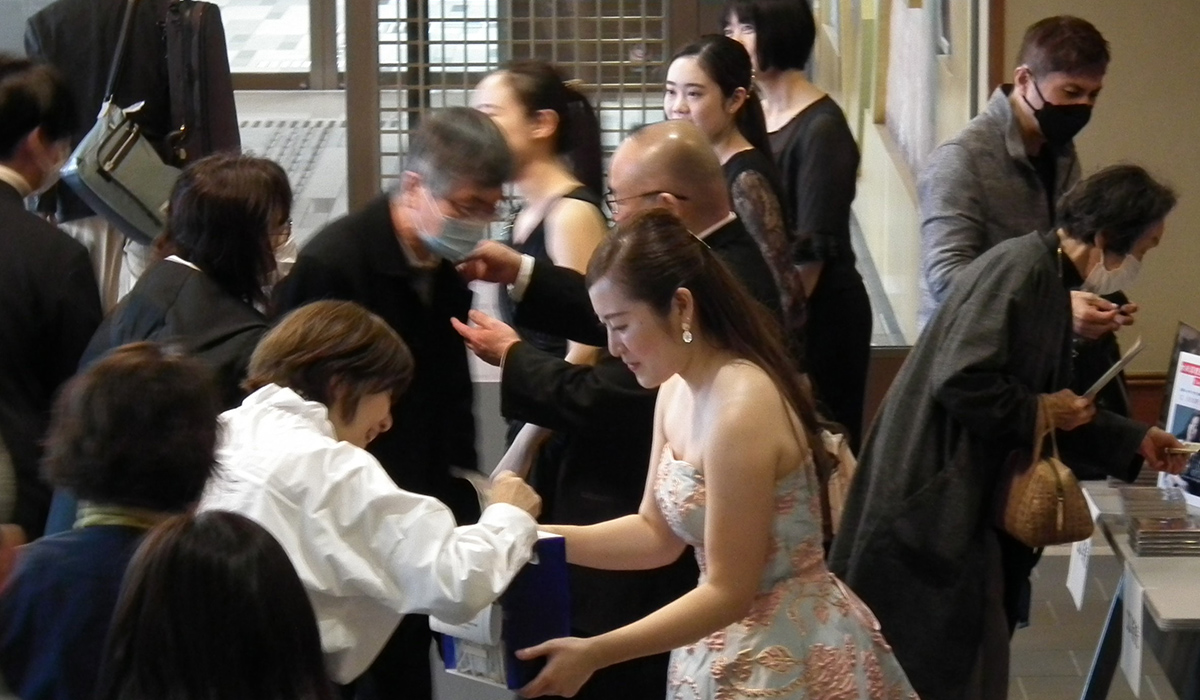 Collecting donations after a charity concert in Kanazawa in April 2024 to support recovery efforts following the Noto Peninsula Earthquake
The 15th Anniversary as a New Beginning
What kind of musician does Marie Kiyone hope to become over the next five, 10 or 15 years? She has not mapped out her future in precise detail. Her career has included many disappointments and experiences that did not unfold as she had hoped. Looking back, however, she realizes that she has experienced far more than she imagined when she was younger and has become involved in activities she could never have anticipated at the time.Over the next five or 10 years, she hopes to move beyond even what she can currently imagine. As people grow older, some things can no longer be done in the same way as in youth. In their place, however, comes the accumulated value of experience. “I hope the experiences I have been fortunate enough to gain will bear fruit and be properly reflected in my music. I want to continue approaching music with sincerity,” she says.
There is one more commitment she hopes to carry forward: connecting Japan and Poland. Exchange between the two countries through Chopin and classical music already has a long history. Kiyone, however, hopes to widen that circle. Rather than limiting the relationship to people directly involved with Japan and Poland, she wants to introduce the cultures and attractions of both countries to people in third countries and create new forms of exchange. Nor does this have to be limited to music.
“Food is one example. There are still so many aspects of Polish culture that people know very little about,” she says. Having lived in Poland for eight and a half years, she has experiences and perspectives that she is uniquely positioned to share.
Kiyone’s role in “connecting” people therefore means more than performing Chopin as a pianist. It also involves awakening curiosity about the country, culture and people from which his music emerged. Fifteen years ago, she was a young international student devoting all her energy to preparing a single recital. Today, she has become an artist who communicates with audiences through music, brings people together and considers how music might connect countries and cultures.
On September 27, Schumann, Brahms and Chopin will fill Yamaha Hall in Ginza. Their music will testify to the 15 years Marie Kiyone has traveled — and, at the same time, mark a new step toward everything that lies beyond.

Marie Kiyone 15th Anniversary Piano Recital
Date and time: Sunday, September 27, 2026 (Doors open at 1:30 p.m.; performance begins at 2:00 p.m.)Venue: Yamaha Hall, Ginza, Tokyo
Program:
Robert Schumann Arabeske in C Major, Op. 18
Johannes Brahms Piano Sonata No. 1 in C Major, Op. 1
Frédéric Chopin
Scherzo No. 1 in B Minor, Op. 20
Scherzo No. 2 in B-flat Minor, Op. 31
Ballade No. 3 in A-flat Major, Op. 47
Ballade No. 4 in F Minor, Op. 52